E.N.D. To Be Informed
You do not have the luxury to not be tapped in. By Julienne Anderson


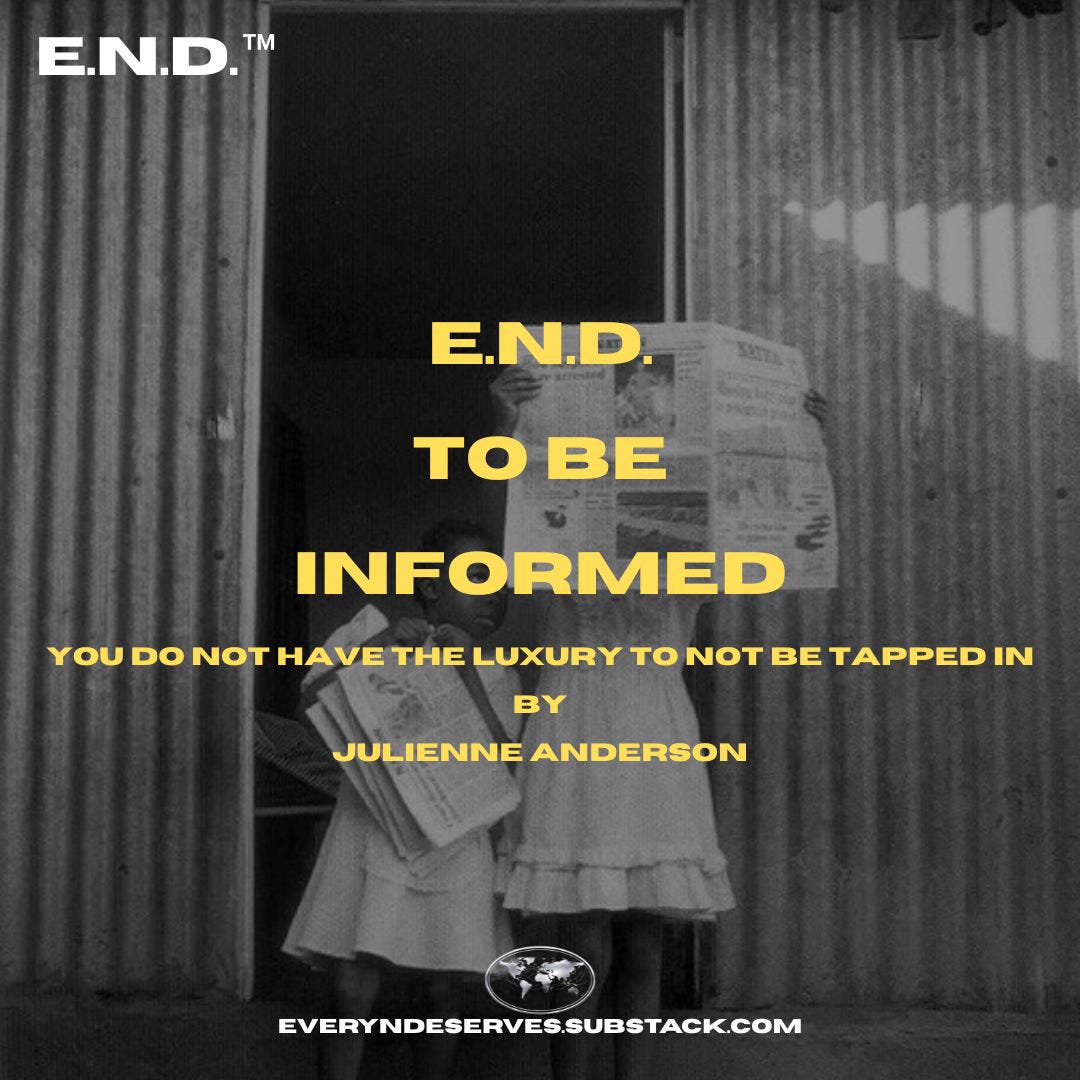
Politically that is.
I know, I know. The world feels like it’s on fire, and it’s much easier to doomscroll, binge Love Island, or let your favorite podcaster give you their hot takes on current events. But as this administration has shown, we can’t afford the luxury of checking out.
Growing up, I hated listening to NPR. It’s all my father played on the drive to and from school. I thought every host sounded like they were talking with a mouth full of spit. Childish, I know. But I was a child. I didn’t care about George W. Bush, wars in the Middle East, or the housing bubble. I didn’t understand how any of it affected me.
But I’m not a child anymore. And neither are you.
The older I’ve gotten, the more I’ve realized that the stories I ignored as a child all impacted me. The decisions made in Washington decades ago affect my mortgage today, my daughter’s daycare options, my healthcare, and the cost of groceries. Everything is connected, whether we pay attention or not.
At the same time, staying informed feels harder than ever. The man in the Oval Office lies with ease. Many major media outlets are now owned by billionaires who seem more interested in protecting their interests than informing the public. News is fragmented, politicized, hidden behind paywalls, and increasingly designed to provoke outrage rather than understanding.
But we don’t just need more information. We need a way to consume it that doesn’t leave us overwhelmed.
For me, that’s NPR.
NPR is a nonprofit and nonpartisan news organization that approaches stories with depth and curiosity. Its hosts bring in reporters, scholars, policymakers, and subject-matter experts to help listeners understand complex issues from multiple perspectives. When conflict between Israel and Iran escalated, I learned why the Strait of Hormuz matters to the global economy. I’ve gained a deeper understanding of Supreme Court decisions on issues like conversion therapy, the economic impacts of changes to VA loan programs, and even the surprisingly rich history behind the viral Savannah Bananas.
What I appreciate most is that NPR doesn’t rush listeners toward outrage. It isn’t built around clickbait or ragebait. It assumes that people are capable of engaging with nuance and builds its stories around this assumption.
As a former social studies teacher, I especially value the way NPR approaches learning. Complex topics are broken down without being oversimplified. The reporting provides historical context, competing viewpoints, and thoughtful analysis. Instead of leaving me overwhelmed by the news cycle, it helps me understand it.
Oddly enough, that keeps me from spiraling and pushes me to action. The more informed I am, the less powerless I feel. NPR helps transform stories that seem enormous and overwhelming into something I can actually comprehend. It replaces panic with perspective and apathy with engagement.
Now, whenever I see an alarming headline, I search the NPR app for a story that can explain more.
The quote “you don’t do politics but politics is certainly doing you” is right. Gas is $5 dollars some places. I spent $100 at the grocery store and only filled up two baskets.
And the only way to fix these things is to clue ourselves back in and create the world we wish we would’ve inherited.
Unfortunately, millennials and Gen Z inherited a chaotic media landscape. But we’re far too old to keep pointing fingers and whining about how hard it is to get good news. If we want to stay informed without becoming consumed by the news, we have to be intentional about where we get our information.
My parents probably never imagined that the little girl rolling her eyes in the backseat would one day become a devoted listener. But they understood something I didn’t: citizenship requires curiosity. In an era of misinformation, outrage, and endless content, that may be one of the most valuable habits we can cultivate.
You owe it to yourself, your children, and future generations to tap in now!
By subscribing, you are directly investing in Black writers, Black ideas, and the future of independent Black media. Every membership helps us commission stories, platform new voices, and continue building E.N.D. into a living hub for revolutionary thought, culture, education, and community.
Thank you for helping us build something that belongs to us.
 | A guest post by
|